1. Introduction
In recent years, the maritime industry has witnessed rapid development of remote and autonomous navigation technologies, giving rise to so-called Maritime Autonomous Surface Ships (MASS). These technologies promise improvements in safety, efficiency, and sustainability, but they also require a clear international regulatory framework. In response, the International Maritime Organization (IMO) has initiated a process to analyze and define regulatory instruments suitable for these new operational realities. (imo.org)
2. Early Recognition (circa 2015–2017)
The IMO first took notice of autonomous shipping around 2015, when the United Kingdom, together with the International Association of Institutes of Navigation (IAIN) and the Institute of Marine Engineering, Science and Technology (IMarEST), submitted a document to the Maritime Safety Committee (MSC) addressing the regulatory framework and application to maritime autonomous systems. MSC 95 acknowledged the submission but did not immediately initiate structured work. (academic.oup.com)
In 2016, IMO’s strategic planning highlighted the need to define MASS categories and operational strategies, paving the way for more focused regulatory discussions.
By 2017, IMO’s Assembly adopted Resolution A.1110(30) (Strategic Plan 2018–2023), recognizing the integration of new technologies into the regulatory framework as a key strategic objective. (academic.oup.com)
3. Regulatory Scoping Exercise (2018–2021)
3.1. Launch
Between 2018 and 2019, the MSC, together with the Legal Committee (LEG) and the Facilitation Committee (FAL), launched a Regulatory Scoping Exercise (RSE) to review existing IMO instruments and assess their applicability to autonomous vessels. (imo.org)
3.2. Objectives
The RSE analyzed numerous instruments, including:
- SOLAS (Safety of Life at Sea),
- COLREGs (Collision Regulations),
- STCW (Standards of Training, Certification and Watchkeeping),
- SAR (Search and Rescue),
- FAL Convention, and
- Other legal instruments on liability and compensation.
The aim was to determine:
- Which existing rules already apply to MASS;
- Which rules require amendments or interpretations;
- Which rules are not applicable. (imo.org)
3.3. Completion
The RSE concluded in 2021, with results approved by MSC 103, LEG 108, and FAL 46. The exercise identified gaps in areas such as watchkeeping, remote operator responsibilities, port interactions, and cybersecurity. (imo.org)
4. Interim Guidelines and Regulatory Instruments
4.1. Interim Guidelines for MASS Trials
In June 2019, the MSC approved the “Interim Guidelines for MASS Trials” (MSC.1/Circ.1604) to enable controlled trials of autonomous and remotely operated ships while maintaining safety standards equivalent to conventional ships. (imo.org)
These guidelines are non-mandatory but provide states with a framework to authorize pilot projects, including requirements on personnel competence and risk management, such as cybersecurity.
4.2. Alternative and Equivalent Approvals
The IMO also provides a framework for innovative technologies through MSC.1/Circ.1455 – Guidelines for the Approval of Alternatives and Equivalents, allowing states to recognize solutions equivalent to existing standards, including advanced automation. (dnv.com)
5. Towards a Dedicated MASS Code
5.1. Roadmap for the MASS Code
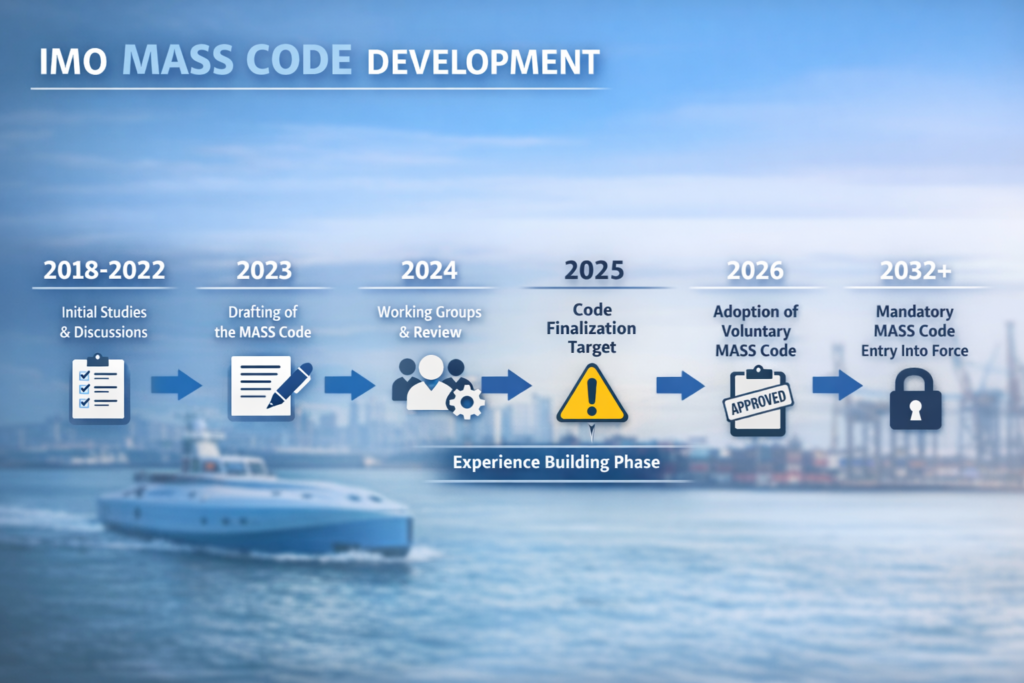
Since late 2021, IMO has outlined a roadmap for a goal-based MASS Code:
- 2025 – Adoption of a voluntary non-mandatory MASS Code as a reference framework (not matched)
- 2026–2028 – Experience-Building Phase: collection of operational data from initial deployments.
- 2028–2030 – Development of a Mandatory MASS Code with revisions to SOLAS and other instruments.
- Entry into force of the Mandatory Code: 1 January 2032. (imo.org)
5.2. Joint Working Group Activities
A Joint Working Group of MSC, LEG, and FAL addresses cross-cutting issues such as terminology, master/remote operator roles, liability, and system control requirements. (imo.org)
6. Updating Existing Instruments
Existing IMO instruments are also being reviewed and adapted:
- COLREGs – to address lookout and collision avoidance responsibilities.
- SOLAS – to update watchkeeping, equipment, and functional requirements.
- STCW – to define qualifications and certification for remote operators.
FAL – to adapt documentation and communication procedures. (debuglies.com
7. Conclusion
Since initial recognition in 2015, IMO has gradually built a regulatory framework for remote and autonomous navigation. Through detailed analysis, interim guidelines, a dedicated MASS Code, and coordinated committee work, IMO is establishing a regulatory pathway that, although not yet fully mandatory, guides the transition toward internationally harmonized autonomous shipping operations. (academic.oup.com)
| Year | Event / Instrument | Notes |
| 2015 | First submission on autonomous shipping to MSC 95 (UK + IAIN + IMarEST) | Recognized need to consider regulatory framework for maritime autonomous systems. |
| 2016 | IMO Strategic discussions | Highlighted MASS categories and operational strategies. |
| 2017 | IMO Assembly Resolution A.1110(30) | Strategic Plan 2018–2023 identifies integration of new technologies as key objective. |
| 2018–2019 | Regulatory Scoping Exercise (RSE) launched | MSC, LEG, and FAL analyze applicability of existing instruments (SOLAS, COLREGs, STCW, SAR, FAL, liability). |
| 2019 (June) | MSC.1/Circ.1604 – Interim Guidelines for MASS trials | Provides framework for controlled testing of autonomous ships, including personnel competence and cybersecurity. |
| 2019 | MSC.1/Circ.1455 – Guidelines for Approval of Alternatives and Equivalents | Enables recognition of innovative or alternative technical solutions under existing IMO standards. |
| 2021 | Completion of RSE | Gaps identified in watchkeeping, remote operator responsibilities, port interactions, and cybersecurity. |
| 2021 (late) | Roadmap for MASS Code defined | Outlines steps toward voluntary and eventually mandatory MASS Code. |
| 2025 | Expected adoption of non-mandatory MASS Code (not matched) | Provides a reference framework for safe operation of autonomous ships. |
| 2026–2028 | Experience-Building Phase | Collection of operational data from initial MASS deployments. |
| 2028–2030 | Development of Mandatory MASS Code | Includes revisions to SOLAS and other instruments; preparation for enforcement. |
| 2032 (Jan 1) | Entry into force of Mandatory MASS Code | Full regulatory integration of MASS into international maritime law expected. |